

BLOG
How to Test Flame-Resistant (FR) Fabrics: A Complete Guide
[ 25.07.2026]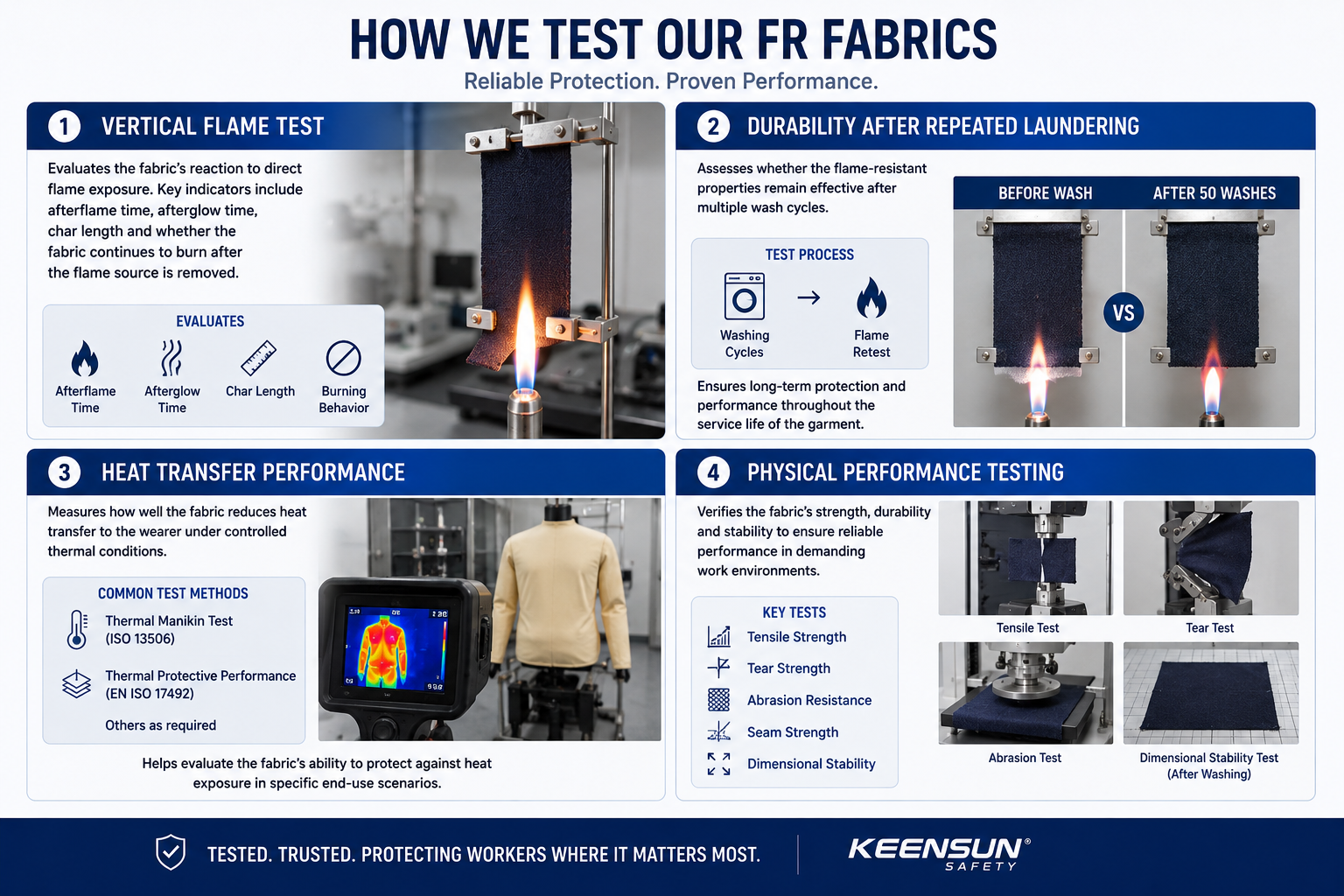
How to Test Flame-Resistant (FR) Fabrics: A Complete Guide
Introduction
Flame-resistant (FR) fabrics are designed to protect workers from heat, flames, molten metal splashes, and arc flash hazards. However, not all FR fabrics provide the same level of protection.
To ensure worker safety, FR fabrics must undergo rigorous laboratory testing according to internationally recognized standards. These tests evaluate how fabrics behave when exposed to flame, heat, electrical arcs, and repeated laundering.
In this guide, we'll explain the most common FR fabric test methods, what each test measures, and why they matter when selecting industrial PPE.
Why FR Fabric Testing Matters
Proper testing helps manufacturers and buyers:
- Verify flame resistance
- Meet international PPE regulations
- Compare different FR fabrics
- Ensure consistent product quality
- Protect workers in hazardous environments
Without certified testing, it is impossible to know whether a fabric will perform safely in real working conditions.
1. EN ISO 15025 – Limited Flame Spread Test
This is one of the most fundamental tests for flame-resistant fabrics.
The fabric specimen is exposed to a small flame for a specified period. After the flame is removed, technicians measure:
- Afterflame time
- Afterglow time
- Hole formation
- Flaming debris
The fabric should self-extinguish quickly without continuing to burn.
This test forms the basis of many European FR standards, including EN ISO 11612.
2. EN ISO 11612 – Protection Against Heat and Flame
EN ISO 11612 is the primary European standard for protective clothing against heat and flame.
Rather than being a single test, it combines multiple performance tests covering:
- Limited flame spread (A1/A2)
- Convective heat (B)
- Radiant heat (C)
- Molten aluminium splash (D)
- Molten iron splash (E)
- Contact heat (F)
Different working environments require different performance levels.
3. IEC 61482-2 – Arc Flash Protection
Electrical workers face another major hazard: arc flash.
IEC 61482-2 evaluates how FR garments perform during an electrical arc event.
Two common methods include:
- Box Test (Class 1 & Class 2)
- Open Arc Test (ATPV / EBT)
These tests determine how much thermal energy a garment can withstand before causing second-degree burns.
4. EN 1149-5 – Electrostatic Properties
Some workplaces involve flammable gases or explosive dust.
EN 1149-5 measures anti-static performance to reduce electrostatic discharge.
This standard is commonly required in:
- Oil & Gas
- Petrochemical
- Chemical Processing
5. ISO 15797 – Industrial Washing Durability
Industrial PPE must maintain protection after repeated laundering.
ISO 15797 evaluates how garments perform after industrial wash cycles, including:
- Dimensional stability
- Appearance
- Fabric durability
- Protective performance
High-quality FR fabrics should continue meeting certification requirements after repeated washing.
6. Color Fastness Testing
FR fabrics should also retain their appearance during use.
Typical tests include:
- Washing fastness
- Perspiration fastness
- Light fastness
- Rubbing fastness
7. Physical Performance Testing
Besides flame resistance, laboratories also evaluate:
- Tensile strength
- Tear strength
- Abrasion resistance
- Pilling resistance
- Seam strength
These properties ensure long-term durability.
Third-Party Certification
Reliable manufacturers usually work with independent laboratories such as:
- SGS
- Intertek
- Bureau Veritas
Independent testing provides objective verification that fabrics comply with relevant standards.
How to Read an FR Fabric Test Report
When reviewing a laboratory report, buyers should confirm:
- Test standard
- Test method
- Sample description
- Laboratory accreditation
- Test results
- Pass/Fail conclusion
- Report validity
Always verify that the report corresponds to the actual fabric being supplied.
Common Mistakes Buyers Make
Many purchasers focus only on certification labels without reviewing the underlying test reports.
Common mistakes include:
- Confusing EN ISO 11612 with EN ISO 15025
- Ignoring industrial washing performance
- Assuming all Modacrylic fabrics perform equally
- Not checking arc flash ratings
- Accepting expired test reports
Conclusion
Testing is the foundation of flame-resistant protective clothing. Standards such as EN ISO 15025, EN ISO 11612, IEC 61482-2, EN 1149-5, and ISO 15797 ensure that FR fabrics provide reliable protection in demanding industrial environments.
For PPE buyers, understanding these test methods makes it easier to compare fabrics, verify certifications, and select garments that offer both safety and long-term performance.
[Back]